A Practical Connector Selection Guide for Medical Device Engineers
Connectors in medical devices must meet electrical, mechanical, environmental, and service requirements at the same time. An effective selection process starts with the system interface, then narrows the options by connection method, contact configuration, and mounting style, while carrying key requirements into the verification plan.
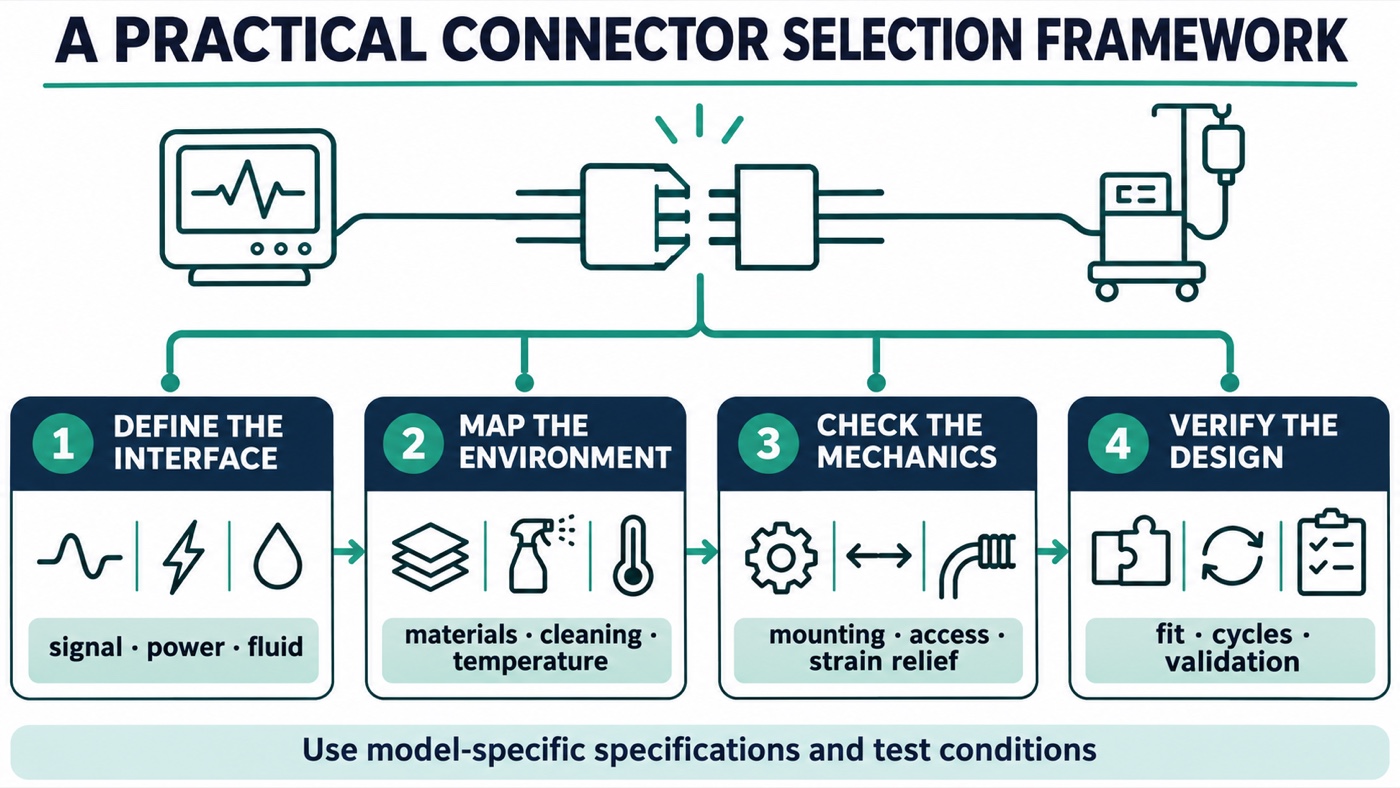
Define the interface requirements
Identify whether the connector carries signals, power, or fluid, and determine whether the channels need to be isolated from one another. Then define the contact count, signal types, operating current and voltage, shielding or grounding needs, and whether different channels must share one interface. Recording these requirements in a checklist makes alternatives easier to compare consistently.
Assess the operating environment
Consider the temperatures, humidity, liquid exposure, cleaning agents, vibration, and shock the connector may encounter during operation and maintenance. Select housing and insulating materials to suit those conditions, and check that the sealing requirement matches the actual mated state, installation method, and exposure. If the device is disinfected or sterilized, treat the specific method, number of cycles, and material compatibility as explicit design inputs.
Check mechanical and handling constraints
Compare straight or right-angle configurations and panel or PCB mounting against the available space, mating direction, cable routing, and service access. Also consider the required locking and release action, cable strain relief, room for hands and tools, the chance of accidental contact, and whether service personnel can make the connection reliably in the intended setting.
Turn reliability needs into verification activities
Based on expected use frequency and service life, define verification activities for connection cycles, contact stability, retention, vibration, temperature and humidity, cleaning exposure, and cable pull. Where mis-mating or accidental disconnection could create a problem, assess keying, coding, or other prevention features. Test conditions should reflect the device’s real operating and maintenance workflows as closely as practical.
Document a reviewable selection rationale
The selection record should capture the interface and electrical requirements, environmental and material needs, mechanical constraints, handling and mis-mating controls, expected service life, and corresponding verification methods. Comparing candidate solutions against the same requirements makes trade-offs clear and supports later design reviews and change control.
Design review checklist
- Interface functions, channel count, and electrical requirements are defined
- Operating, cleaning, and environmental conditions are included in material and sealing assessments
- Available space, mating direction, service access, and cable strain have been reviewed
- Locking, release, and mis-mating prevention suit the intended use
- Life and environmental requirements have been converted into executable system verification activities
- Key assumptions, trade-offs, and verification results are documented
Connector selection is not a matter of comparing one parameter in isolation. It is the process of aligning interface functions, device environment, mechanical integration, and verification needs. Defining those conditions early helps narrow the options and reduce late design changes.
This is a general engineering selection guide. Final design decisions should be reviewed against project requirements, applicable standards, and verification results.